Notes DB 93 Theological Genocide - 2025
Sunday 28 December 2025 - Saturday 3 January 2025
[page 210]
Sunday 28 December 2025
Long conversation with JC. Catching up on last week notes
[page 211]
Monday 29 December 2025
Books for Profs:
Gerard O’Brien
Jonathan Opie
Philip Gerrans
Antony Eagle
Garrett Cullity
Physics article: An alternative to QFT [CC_QFT_alt_Jan2026]
Abstract: From Minkowski space to initial singularity
1. Initial symmetry
2. Initial aingularity Aquinas + Einstein
2a. Zero energy - Stationary Lagrangian
3. Fixed point theory and Hilbert space
4. Superosition, quantum mechanics and hermitian operators
5. A qubit ψ = α|fermion⟩ + β|boson⟩
[go to page 213]
Letter to Fellow search: John D. and Catherine T. MacArthur Foundation Office of Grants Management 140 S. Dearborn Street Chicago, IL 60603-5285 To: 4answers@macfound.org
I would be surprised if your search for potential fellows would ever encounter me so, following Martin Luther’s initiative for theological and religious reformation, I have decided to knock on your door.
I am 81. In my 20s I was a solemnly professed monk in the Australian Province of the Dominican order and a keen student of Thomas Aquinas (1225-1274). Aquinas \ radically revised Christian theology by introducing the newly translated work of Aristotle.
At the time of [the] work of the Second Vatican Council there was a call for ideas to assist the work of the Council. I suggested to my superiors that the time had come to convert theology from poetry to science by repeating Aquinas’s Ansatz with the hypothesis that the universe is divine. We could approach the mind of God in the same way that we approach human minds, through body language, where God’s body is the physical universe. In effect our experience of the universe and ourselcves would became a living “Bible".
From a Roman Catholic point of view, this idea is heretical and I was ejected from the Order and my vows annulled.
Now, 60 years later, I have published a book: Cognitive Cosmogenesis: a systematic integration of physics and theology. The core idea is that the statistical structure of the communication we receive from the physical universe is identical to the statistical structure of all human communication as defined in Claude Shannon’s Mathematical Theory of Communication. The divine world tells us what “God” is thinking. Jeffrey Nicholls (2025): Cognitive Cosmogenesis: A systematic integration of physics and theology
Doctors no longer have borders because scientific biology has unified our understanding of human physiology. My work can create a similar unity in care of the human soul by emphasizing our spiritual unity in a divine universe. This will reduce the incidence of misunderstanding and conflict at human theological and religious interfaces.
In the last chapter of my book I note the political consequences of gravitation and quantum mechanics when extrapolated through symmetry with respect to complexity from elementary particles to human affairs. A draft of an essay suggesting this possibility is available at Essay l4l01: Quantocracy: The universal quantum mechanical foundations of democracy and freedom
I see my current book as analogous to the First Part of Aquinas’s Summa of Theology, and I am currently engaged in following this analogy into the areas of politics, ethics, spirituality and care for our only divine planet.
Yours sincerely,
Jeffrey Nicholls (BA (hons) Adelaide.
Tuesday 30 December 2025
Developing CC_QFT_alt_Jan2026 and Commentary cl4l05_particles in parallel. My developments are exciting but also rather tentative but I am bouyed by a combination of the heuristic of simplicity and Feynman’s doctrine “a physical understanding is completely unmathematical.” The gigantic hiatus in my life is that I am completely alone with no collaborators in my quest for a divine unverse symbolized by Cognitive Consciousness, but perhaps my book will bring me someone. Now to the market, 08:17
[page 212]
Everything is gorgeous and progressing beautifully but lonely, a partner and a collaborator would be good, but $1000 days are heartening. Putting everything on the icloud, cheaper than local storage [and rediscovering my old subscription to Clean my Mac]
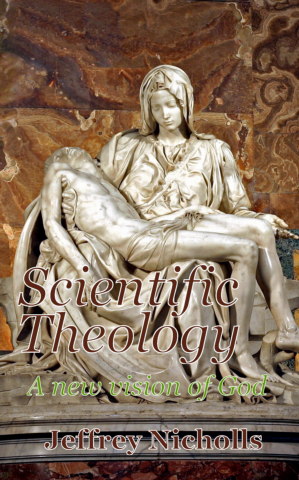
Tweet: In our divine universe the physical world is the living “Bible” speaking to us through our own senses and imaginations. I have a new view of the creative and inspired scribes and priests who wrote traditional sacred texts for their old masters. I want to rewrite their old books [280 char, posted with book image]
Chaitin’s version of Gödel’s proof tells us that there are limits in universal information density ie no matter how we look at a photon or any other qubit we only get one bit of information and the quantum computation people who think we can treat quantum mechanics as a continuous (complex) analogue machine are barking up the wrong tree. The entropic content of a quantum process is the log of the dimension of the Hilbert space and determines the number of eigenvectors that we can extract. We have to carefully distinguish between the frequency of events in a probabilistic sense and the actual details of the events (like which side of the coin is showing) which eventuate. Gregory J. Chaitin (1982): Gödel's Theorem and Information
Posted a copy of CC to Editor: Conversation Media Group Ltd Tenancy B level 5 700 Swanson St, Carlton 3053.
Wednesday 31 December 2025
Dear Conversationalists,
I am not an academic but would like to bring your attention to my book which is aimed at reducing religious conflict around the planet.
[page 213]
Reading Dirac for insight to put into CC_QFT_alt_Jan2026, looking for a pure statement of quantum mechanics to put in the initial singularity in QFT_alt. What we need is superposition and self adjoint operators with real diagonals — this is the mathematical core of QM, “selective pressure” from QM to real, but how did we get complex in the beginning? Why waves? [the only source can be randomness, positive events occurring at intervals, the pendulum again]. Paul A M Dirac (1983): The Principles of Quantum Mechanics (4th ed)
Dirac’s error, and that of most pundits, is the concentration on the probability of quantum events rather than the concentrating of precision of events which QFT defines through diagrams adding the possibilities of particular hermitian operators which Feynman finds by his path integral. Here we assume that the path integral is always stationary on one quantum of action = one logical operator in the domain of elementary particles [assuming that energy is released one quantum at a time by the zero-sum bifurcation of gravitation (reference to appear in Lust–4–Life in 2026).
Hamiltonian operators and global stability. These operators embrace the exclusion principle and all the other stable states on the basis that only real numbers are real, but where do the waves come from? Randomness controlled. [I had an idea at the beginning of the paragaph which I refrained from writing in and now it has escaped me, damn]. It relates to the stationarity of the combined Lagrangian of a fermion and the associated boson, either emitted or absorbed [see comment on gravitation above].
From page 211 re CC_QFT_alt_Jan2026:
6. Gödel, Chaitin and the entropy of explanation, including the heuristic of simplicity and the principle of symmetry w.r.t. complexity.
[page 214]
Tomonaga and Feynman on the ‘incomptence’ of QED. Sin-Itiro Tomonaga (1965): Nobel Lecture: Development of Quantum Electrodynamics
Summing up, the mechanism of quantum mechanics working in the complex domain creates and feeds into Minkowski space in the real domain and the operational perfection of this transition is measured by hermitian operators which arrange the superposition of complex vectors to yield real numbers.
The first appearance of the complex domain in theological history is in the treatment of the Trinity by Augustine of Hippo. Augustine (419, 1991): The Trinity
Dirac Mathematics: in quantum mechanics causality is implemented by linear superposition with adjustment of phase.
Thursday 1 January 2026
A new year and back to cl4l05_particles, announcing my discovery that the inertial symmetry of Minkowski space shows that it is the result of pure quantum theory in Hilbert space with no reference to spacetime so that every point in Minkowski space is equivalent, and the speed of light, rooted in quantum electro dynamics [beneath Minkowski space] is a local phenomenon, identical for every observer as Einstein found and so demands the Lorentz transformation and the Minkowski infinitesimal metric to connect distant events in Minkowski space, so establishing the [classical] spacetime light cone.
[page 215]
Love is the cosmic boson. In a physical universe inspiration is the direct work of the divinity, manifest in this sentence while listening to Kpop NewJeans ETA. Kpop: NewJeans: ETA
Gross: Yang: “Symmetry dictates interaction. The first example of this was general relativity where Einstein employed the symmetry of space-time [a consequence of quantum theory] under local changes of coordinates to determine the laws of gravity.” [listen to what Einstein said:
The postulate of relativity in its most general formulation (which makes space-time coordinates into physically meaningless parameters) leads with compelling necessity to a very specific theory of gravitation that also explains the movement of the perihelion of Mercury. However, the postulate of general relativity cannot reveal to us anything new and different about the essence of the various processes in nature than what the special theory of relativity taught us already.Chen Ning Yang (1957): Nobel Lecture: December 11, 1957: The Law of Parity Conservation and Other Symmetry Laws of Physics, David J Gross (1996_05_11): The role of symmetry in fundamental physics, Albert Einstein (1915): The Field Equations of Gravitation
Here we are getting to the proof of the divinity of the universe to be incorporated in L4L via the ten steps to the divine world.
Gross: “Gauge theories have assumed a central position in the fundamental theories of nature . . . Gauge invariance forced the existence of special particles, gauge bosons, . . . massless spin one particles that are associated with vector potential and mediate the forces.” And we think they are a consequence of the zero-sum bifurcation of gravitation which builds on the equivalence principle that in pure gravitation pure energy is both fermion and boson, so we have ψ = |fermion⟩ + |boson⟩> at all scales (see Yang above).
Fibre bundle . . .’ a sophisticated geometrical concept [which] has provided a deep and beautiful geometrical foundation for gauge symmetry’ (and, I imagine in violation of the heuristic of simplicity at this level of complexity [the 64$ question is how all these fancy ideas are physically realized]).
[page 216]
Gross: ‘ It has also been understood, a century after Maxwell discovered his equations that the vector potential is not just an artificial construct but has a direct observational meaning, This is most evident on the Bohm-Aharanov effect where an electron beam propagates in a region where there is no EM field yet due to the geometry the vector potential is non-vanishing [once again an inappropriate introduction of geometry before it actually exists?] Due to the change of phase that accompanies a charged particle moving in a background vector potential one can observe interference effects directly. The vector potential [ie photons] is primary ‘ a co-creator of Minkowski space. Akira Tonomura (2006_04): The Aharonov-Bohm effect and its applications to electron phase microscopy
‘ Indeed today we believe that global symmetries are unnatural. They smell of action at a distance. We now suspect that all fundamental symmetries are local gauge symmetries. Either all broken or approximate.’ [This means that they arise from local interactions of fermions and bosons].
This Poincare invariance can be regarded as a residual symmetry of the Minkowski vacuum under changes of coordinates. [My much better (?) explanation at the bottom of page 214]
Gross: The origin of symmetry; Obviously implicit in the structureless simplicity of the initial singularity, the first quantum of action, which is a closed system acting on itself as Augustine realized. Obviously the first symmetry is right before our minds, as Aquinas realized.
As we explore physics at higher and higher energy, revealing the structure at shorter and shorter distances we discover more and more
[page 217]
symmetry. The symmetry is usually broken or hidden at low energies. [This may just be an excuse to build bigger accelerators. Becasue the quantum of action is so small, the real place to see things in Minkowski space where we live is small distances which imply high momentum, but there is nithig more fundaemntal that the quantum of action ≡ initial singularity]
Copy of book to Adelaide U prof of Physics Copy to David J Gross - email and print ready PDF posted.
Gross: ‘Foremost among these is supersymmetry that has the ability to unify bosons And fermions into a single pattern, to unify matter and force [as we see already in gravitation] and to help explain the mysterious fact that the mass scale of atomic and nuclear physics is so much smaller than the scale determined by gravity (the hierarchy problem) . . . [looks like another renormalization problem]. Hierarchy Problem - Wikipedia
String theory is the most ambitious candidate for a unified theory of all the interactions that naturally embodies in a consistent fashion quantum gravity. String theory - Wikipedia
Gross: “Thus once again we are embarked on a new stage of exploration of fundamental laws of nature, a voyage guided largely by the search for and the discovery of new symmetries.
I would like to do everything by symmetry, but I will stick with trying to express Maxwell’s equations in quantum mechanics without using fields in spacetime. The ‘vector potential’ is a spacetime thing but the Bohm-Aharanov effect suggests that is is a pure quantum thing, a superposition of abstract ‘waves’ ie periodic functions, something to do with hermitian operators.
[page 218]
Behel: In Minkowski space where Lagrangian operates fermions [and bosons] come in mating pairs probably with zero energy, like a pendulum, massive fermions made of kinetic, massless bosons made of potential, so Lagrangian L = T − V remains stationary at zero,the basic symmetry is in effect equivalence. We see this in gravitation where mass is both fermion and boson, ie essence ≡ existence, form ≡ energy. So we decide energy is like substance / matter, but mass and energy are also equivalence, massive fermions, massless bosons (mostly)? Non mathematical dreaming. What are the real quantities in quantum mechanics. [at the quantum level the vector potential does not involve mass, energy or momentum]. Photon energy = Δ orbital energy. Keep shifting the bits until they fit. Its got to be far simpler than the field theorists think. I have to look at Behiel’s derivation of the Maxwell’s equations, mixing up quantum mechanics and classical mechanics as though there is feedback rather than quantum control. Part of the problem of QFT is that it is premissed on the assumption that classical controls quantum but quantum is too real for that via random basis states and hermitian operators [and one suspects that the quantum computers are mistaken when they think they can isolate individual quantum eigenfunctions]. This is the speculation that will lead to a conclusion, the difficult point of making the real world out of quantum mechanics, bit like making life out of genes but in this case quantum mechanics does both the randoms and the selection [and as I have manged to accidentally discover, the route from quantum mechanics to Minkowski space is via particles. Richard Behiel: Electromagnetism as a Gauge Theory
The gravitational situation demands a zero Lagrangian for every qubit, and so we expect all the fermions and bosons appearing in Minkowski space to have a Lagrangian stable at zero and so a balance between fermion and boson.
Friday 2 January 2026
My manifesto for scientific theology, finally bring the most ancient and mystical science out of the hands of imperial autocratic popes and all those mystical pseudoscientists who use their power to get us to believe that they have an infallible connection to a non-existent [invisible] God which entitles them to override all our art and science for their [own] benefit.
In many places these people still enforce their control by claiming the power to imprison, torture and murder heretics, make war and deny the spiritual power of women.
Squish this into a tweet with passion.
All that gauge (ie phase) theories are telling us is that in nature information is encoded in the phase of quanta of action. I do not really understand this but my hunch is that the multidimensional phase encapsulated in a vector in Hilbert space is a logical operator [ie software] which serves as a message which, when uttered by a natural authority, is in infallible command.
It is interesting to me how my understanding of the world has increased incrementally over a lifetime of study and trade to finally arrive that the theory of everything is theology, the universe is divine and the only way to understand it is as a mind — a sheet of corrugated steel is a logical operator in the construction of a dwelling [both an operator and a thing, boson and fermion]. This is where my spiritual manifesto meets technology and my old deceased work mates Bruce Wilson and Graham Ellis.
Saturday 3 January 2026
[page 220]
The Aharanov-Bohm thing is the clincher [demonstrating the foundational role of quantum mechanics]. Electrons are flipped by π by the quantum vector potential in the absence of E and M fields in Minkowski space. [see Tonomura above]
I begin to see why Einstein worked alone. A feeling is a personal thing, a quantum thing that cannot be shared until it gets the energy to be expressed and then it can be shared. My book is a shared feeling that has taken me 60 years to materialize/energize and now it can be shared and start a movement - a bit of cognitive cosmogenesis ie poetry.
Back to Behiel 1:10:1 (started at page 207): ‘Dirac field per se does not have local phase symmetry’, And we begin to invent the photon field in Minkowski space via the Lagrangian to corrct this lack.Because we are using the Lagrangian in Minkowski space, this is not strictly quantum mechanics. We are discussing the EM 4 potential which is an energy thing, not part of quantum mechanics per se but does seem to be sub-Minkowski thrugh the Aharanov-Bohm effect whicg changs electron phase outside the presence of EM fields in spacetime. Richard Behiel: Electromagnetism as a Gauge Theory
[pages of Behiel notes pp 221 - 225]
[page 225]
So now I have watched the whole video and seen a lot of mathematics about distance and time which have nothing to do with quantum mechanics and wonder if in reality everything is much simpler. And in a way the whole thing comes down to the fine structure constant [the “force”, “coupling” between bosons and fermions]. Fine-structure constant - Wikipedia
At present I am stypied but i feel confident that we can start with the qubit ψ = α|fermion⟩ + β|boson⟩ and magine that the vectors representing fermion and boson are normalized, orthogonal and in EM the simplest possible with U(1) symmetry to be ncreased to higher dmensins as we go to higher energied but all is ?? and my next task is to add to cl4l05_particles to woerk toward an answer.
[page 226]
to be also incorporated in l4l_e02_Justice based on gravitation and zero sum bifurcation after Essay l4l01: Quantocracy: The universal quantum mechanical foundations of democracy and freedom on agency and independence. How does this relate to the interaction between fermions and bosons which requires a stationary Lagrangian.
All that QED stuff has shocked me a bit but I still have faith in unrestricted quantum mechanics. Energy makes he photons and electrons/positrons real. Their interactions create Minkowski space but we need to create an analogy of the Dirac equation to get back to the Minkowski track with the spinors — how does a spinor differ from a Hilbert basis state? We have to plot the quantum mechanics behind it and get to the idea that the exclusion principle automatically demands 3D space and the photons add the minus dimension that gives the null geodesics which never get a mention in Behiel. Dirac equation - Wikipedia
We assume that the spinor solutions to the Dirac equation are orthogonal and indistinguishable from Hilbert basis states so we can imagine 4D Hilbert space representing fermions up and down, in the simplest case electrons and positrons. We simply assume that there is enough entropy in each basis to define the associated particle, and there might be much more to each one as Qiu might see. All that is required in a qubit is that the two bases are orthogonal but they could have the entropy of male and female mammals with the occasional [bisexual] superposition. Spinor - Wikipedia, Qiu-Hong Hu (2005_12_29): The nature of the electron
My fondest pleasure is to write something gripping, but it is
[page 227]
not always available. like reading the crime novel, the big question is what is going on in the universe and the problem is the interface between the simplicity of quantum mechanics and the complexity of the world. This is my problem and my way around it is to apply the Gödel Chaitin measure of entropy to the complexity that needs to be explained in Minkowski space which, in the case of QED, is the whole subject of electrical engineering, from power through computation ion to biology. What I can do now is write more about quantum precision and politicd. Quantocracy is good and now I have to get on with the 10 steps and Justice and the big problem with the ten steps is producing analogues of QED and QCD, most of which comes down to explaining the exclusion principle, asymptotic freedom and containment.
The core point if the divine universe is the inspiration that appears in own own minds as we pick up some tool to realize the inspiration with pen, guitar, violin or bulldozer and this brings us into contact wth the people who cooked up the Hebrew Bible, the Dreamtime and all the other human artistic snd industrial constructs with which we have filled and sometimes damaged the world. The root problem with our mental states, which I try to explain in the theory of peace and my book, is to find the psychological space to treat everybody as we would like to be treated in contrast to the widespread notion held by some that they are entitled to more good things and fewer bad things, the effective core of Christianity as opposed to imperialism. The next book, going on from the genetic content of bodies as a source of cooperation must take us back to a quantum mechanical elaboration of justice, as envisaged in l4l_eo3_Justice and the rest of the site.
[page 228]
Behiel’s video was completely about calculus in the relativistic mass shell explaining the work of Faraday and Maxwell and almost nothing about quantum mechanics except phase in space illustrated by arrows.