Notes DB 94 - Theory of Peace - 2026
Sunday 23 August 2026 - Saturday 29 August 2026
[page 301]
Sunday 23 August 2026
Do I have any clear paths forward? Just continue what I am doing. Universe is divine; god is love; QM favours independence and agency; gauge theory conservation of energy, equivalence of fermions and bosons are the foundation of justice, i.e. god is love ≡ fermions, bosons, zero energy and conservation. We have to look for these conclusions in Lust-for-Life. What I am looking for is conformity between a rational understanding of the standard model (ie Boltzmann equation, particulation), and 13 (?) steps to a universe beginning with fixed point theory and particulation via von Neumann. This seems to be the current shape of the project that arose from Plato, Aristotle, Aquinas and Augustine. So we have a new Trinity built on Augustine’s insight into self consciousness fermenting in my own mind since I hammered the cloister in Camberwell East, 816 Riversdale Road. A wishful reconstruction of my past.
The Boltzmann equation depends for its proof on the assumption of continuity. Can we substitute logical continuity for calculus here, ie logic embodies the integro-differential equation with not-not P ≡ P (Augustine + Brouwer).
[page 302]
Harris / Politico - Persuasion vs motivation; respect vs contempt. John F. Harris (2026_08_19): Bill Clinton Turns 80 Today. Does the Old Man Have Character?
Paul Vigna, NYT: Money: a system to distribute resources that, like any other system can be reset. V’s compound inflation avoided in the universe by zero energy and bifurcation [so cash and bank debt are always balanced]. Paul Vigna (2026_08_22): An Ancient Sumerian Solution to Our $40 Trillion Deficit
Bergman: The Seventh Seal: Re Cognitive Cosmogenesis and scientific theology: ‘this is my hand; I can move it.’ ‘She is the cause of the plague, to be burnt tomorrow’. The Seventh Seal - Wikipedia
The Christian story is obviously total bullshit seen in the modern milieu. Christians think they are empowered to kill people they disagree with, like all religious fundamentalists. Playing chess with death: “our crusade was so stupid”. To believe is to suffer. [Try also The Name of the Rose [film]. Jean-Jacques Annaud: The Name of the Rose, The Name of the Rose - Wikipedia
Ezra Klein: Twitter broke the Left; X will break the Right. Ezra Klein (2026_08_23): Twitter broke the Left; X will break the Right
Monday 24 August 2026
[empty]
Tuesday 25 August 2026
Caught up with last week’s notes after following Cercignani and Boltzmann and the application of Jones’s Angels to Hilbert space. Now we expand the Hilbert formalism from abstract quantum mechanics to the logical definition of omnipotence implicit in Hilbert’s formalism, thus laying the foundation for a universe limited only by consistency, ie divine.
Also check Chinese book
[page 303]
fair and hope to make few thousand this week to improve my cash position for book promotion. One must spend to be famous!
The trick now is to promote the notion of a divine universe as a fundamental and safe route to salvation ie heaven (on Earth, in life). What do you want? Peace and happiness. How do you get it? By working with god, not as dictated by the popes but as discovered by science, that is with a secure basis in reality. This can be the basis of the ‘scientific theology manifesto’, for want of a better name, perhaps lust-for-life, moral-algebra or on-creation, or something that sounds attractive to everybody, based on scientific (theological study) of human psychology like the work done by google, facebook, instagram etc, ie instant satisfaction? How do I become a leader? Do I want to be? What is it to be a saviour? Am I too lazy to take it on? To do it I must bring it into my comfort zone, the feeling that makes me pick up a pen as I have done to write this, looking under my chair for a pen and in my back pack, the feeling that underlies the lust for life, the fight for reproduction.
In 20th‑century India, the perfect Hindu wife was… a man. Radhika Raghav (2026_08_25): In 20th‑century India, the perfect Hindu wife was… a man
Post a copy to Tim Winton with the following note: Tim Winton (2026_08_24): This is not a natural calamity: it is being done to us knowingly
Tim Winton,
c/- Jenny Darling & Associates PO Box 5328
South Melbourne VIC 3205
Hi Tim,
I was impressed by your article in the Guardian, This is not a natural calamity: it is being done to us knowingly. . . . There’s nothing accidental or inadvertent about what we’re all suffering through together. We’ve had enough time now and have sufficient expertise to understand that this is not a natural calamity. This is something that is being done to us. Knowingly. Which makes it a crime.
I do not think the use of fossil fuels has always been a crime. From a technical point of view, modern civilization was born when James Watt and Sadi Carnot discovered how to turn heat into work. Since then our activities have no longer been confined to the muscles of people and animals.
This discovery devastated our forests, and put the first dose of new carbon into the atmosphere. Coal, oil and gas might have relieved the forests somewhat but by their exponentially growing release and combustion they have trashed the atmosphere. The worst offender is methane, and we could cut that very sharply by fixing a few million leaky pipes and organic waste dumps.
I have known since childhood that almost all the available energy on the planet comes from the Sun. In 1973 I went to the UNESCO International Solar Energy conference in Paris. I saw the rudimentary state of solar energy utilization, principally for heating, but I also felt the post fossil optimism alive at the time.
We had to wait until the 90s for the first mass production of photovoltaic cells and the development of wind turbines of significant power. Nuclear power made a brief appearance, but it remains insignificant, dangerous, principally supported by its military use and now economically unviable in the face of wind and photovoltaics. Both these solar technologies are now expanding exponentially.
In the face of this technological development, I fully agree with you that the efforts of the fossil fuel industry to extend its life is now verging on criminal, motivated by money hungry relics from the 20th century.
I live in SA and we are now coming to the point where some days all our electricity comes from renewable resources. The rapid advance in battery technology, primarily coming from China, means that electric cars, heavy vehicles, mining and construction machinery are becoming feasible.
I realize that the blame game is fun, but I believe there is more to be gained by promoting the future rather than lamenting the past. Economic pressure will take care of fossil fuel in the long run, and a bit of hot weather certainly helps.
I am writing to promote a book about a far deeper evil which has been with us since the military technology of horses, wheeled vehicles and edged weapons made imperialism possible. Imperialists like the Pharaohs and Romans like Constantine coopted the literate classes of theologians to promote meaningless dreams of salvation. This helped them maintain control of their populations with minimum expenditure on applied violence.
There are approximately 10 million scientists on our world of about 8000 million people, a little over one in a thousand. It seems possible to believe that approximately half of the rest believe in various theological fairy tales about salvation, heaven and hell and the need to martyr themselves when necessary to support these fantasies.
My first five years after school were spent in a Catholic religious Order, the Dominicans. I was being taught how to run an inquisition, the medieval founding role of the Order. I fell in love with the work of Thomas Aquinas whose principal achievement was to turn the Church toward the best science in
his day, the work of Aristotle.
Aristotle and many other Greek scientists were introduced to medieval Europe by Islamic theologians like Averroes and Avicenna.
During the Second Vatican Council, I suggested to the management that it would be good to repeat Aquinas’s work, this time using real science rather than Aristotelian common sense. The real nature of the world has only been revealed to us in the last few centuries. Quantum mechanics and modern logical theory suggest that it is divine and omnipotent, limited only by consistency.
The Dominicans were not dumb. They could see that my position undermined their whole belief system. The enormous wealth that the the Roman Catholic Church acquired when it liquidated “pagan” religions and took all their property would revealed as a psycho-military confidence trick.
Far worse than the fossil fuellers. They at least have contributed to the enormous increase in human welfare made possible by abundant energy. All that false theologies have given us is the endless sequence of wars that have pixellated our history
I was thrown our of the order, and basically went bush for 60 years, working on the book attached to this letter. From the point of view of scientific theology we are all indigenous children created by a divine universe, and the only way to save ourselves is to save our world by treading lightly and living on the Sun and the Wind.
Fossil fuel underwrote the science and technology necessary to live in healthy harmony with the divine world. We must now take advantage of this leg up.
I hope you enjoy my book. The cousins say it is a difficult read, but it is the best I could do, and it would be good to see a few intelligent and gifted people pick up the idea and run with it.
Copy also to Intifar Chowdbury, Flinders University. Intifar Chowdhury (2026_08_14): Friday essay: we’re all ‘political’ now – but can that lead to real change?
Dr Intifar Chowdhury
Jeff Bleich Centre for Democracy and Disruptive Technologies, Flinders University,
Hi Dr Chowdhury,
I admire your enthusiasm and am sending you a book on scientific theology which may be relevant to your work. I see all our trouble in one intimately entangled box. The story starts with a rapid increase in the efficiency of military force maybe 10 000 years ago. This enabled well organized small groups of people with horses, wheels and efficient weapons to conquer vast tracts of land occupied by relatively unwarlike indigenous people like the inhabitants of Australia.
To run an empire you need literate communicators to carry your message to distant borders. This gave agency to literate intellectuals, principally theologians and astrologers. Many of these people devoted their minds to serving the imperium. Thousands of years later I became involved in the Roman Catholic Church because the Christian bureaucrats around the Mediterranean had sold out to Constantine to establish the Holy Roman Empire which became deeply involved in fighting off Islam as well as its own internecine wars.
The purpose of my book is to break this ancient nexus between theology and imperium running through conduits of theology and autocracy and I feel that you and your work are harbingers for a post imperial age. My feeling is that doctors no longer have borders because biological science has taught us that all our bodies work the same way. Theology can follow the same track if accept the scientific view of our spiritual origin in sharing the creative power of the universe that brought us into existence.
The world actually works after 14 billion years of variation and selection and our science, including theology, must lock onto this if we are to have peace and security. Campaigns of outright ego like that waged by Trump and his power hungry analogues can only lead to hell on earth.
Many theologies and religions have deprecated the material world motivated by the delusion that there is a real spiritual domain separate from the world which is our natural home. This is a mistake, the world comprising matter and spirit is all that there is and is a visible and solid foundation for our real intellectual and spiritual unity. This approach contests the picture of the natural world promoted by the Populist Right as described by Slobodian in Hayek’s Bastards. Quinn Slobodian (2025): Hayek's Bastards: The Neoliberal Roots of the Populist Right
Jeffrey Nicholls
Perhaps I will get a better outcome if I rewrite my story as a novel. Maybe my novel could be a rewrite of the abstract man [transcribe, edit and publish?].
Wednesday 26 August 2026
[page 303]
Posted books to Tim Winton and Intifar Chowdbury
Housekeeping: Gas $113; Electricity $791.
How do we remodel the portrait on an abstract man? What is the emotion? Desire for eternal life? Desire for pure intellect? Angelic bliss?
ABC Tampa Crisis; 3 episodes. ABC: Tampa: The Turning Point
Thursday 27 August 2026
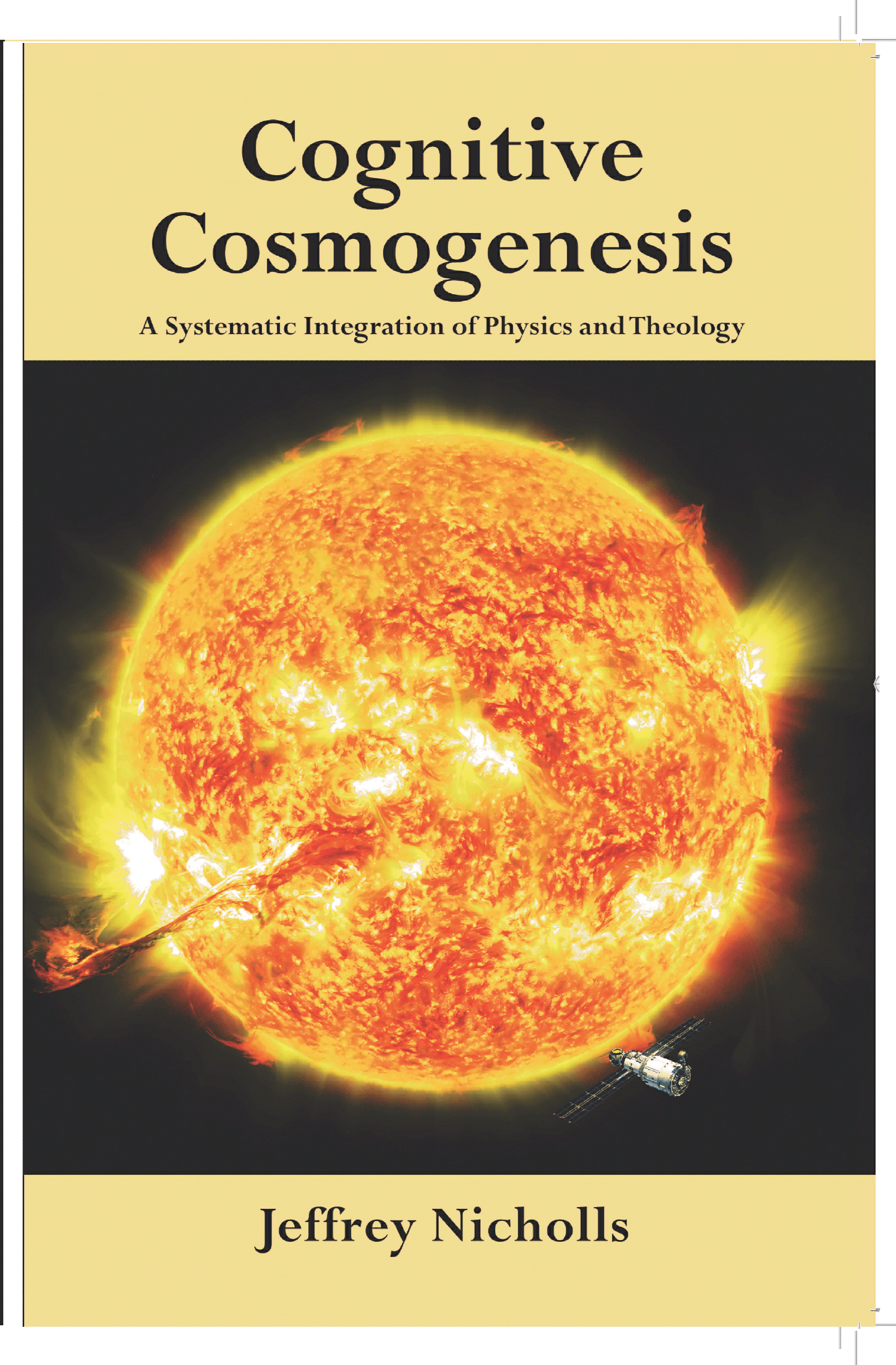
Slow day yesterday. 30 Copies Cognitive Cosmogenesis delivered.
Gutanjali Shree: Allan Scott Auditorium, Hawke Building, 55 North Terrace
Tomb of Sand Gutanjali Shree (2025): Tomb of Sand
India/Pakistan has many religious traditions including a spectrum from Islam through Christianity to Hindu. Science can unity an infinity of technologies so scientific theology can be the foundation of innumerable religions and insofar as it is evidence based it must be accepted as fact but can become the foundation of innumerable interpretations just like the fundamental particles. We might say religion is the business end of theology and Christianity is false insofar as it misinterprets physical theology, promising, for instance life after death when we know that life is the consequence of a very specific arrangement of fundamental particles. We must build this idea into Lust–for–Life along with the idea that the algebraic basis of the Hilbert space
[page 305]
of quantum mechanics is quite capable of spanning the whole of Hilbert’s formalism so suggesting that it is the foundation of an omnipotent system spanning the full space of consistency as Aquinas has claimed, perhaps gaining this insight from Islamic theology [given the view that the essence of god is identical to their existence and existence is per se possible.]
Sometimes my work feels a bit boring when there is a long gap between ideas, but a move out of logic and physics may open up more space for dreaming, The home page will follow the gauge theory to the end of insight, agency and justice and then we can turn to the religious applications of quantum / Aquinas / Einstein foundations of the world (quantum ≡ Hilbert (space and formalism)
Whitney Houston: I will always love you: The emotional core. Whitney Houston: Will Always Love You (Official 4K Video)
Friday 28 August 2026
LADW: Chapter 4: Spectral Theory. Now I m getting back in my groove. My last few weeks have been a bit dissociated and I think this has been related to my new prosthetic teeth and my forthcoming cataract operation, but this all now in safe hands and my future health is asured, and I am looking forward to the first payment from my book next month. Now I have a relatively firm vision for my future writing. The meeting with Gutanjali Shree last night led me to note that science, like scientific theology, can underlie an
[page 306]
infinite spectrum of technologies, religions and Shree’s discussion of the interaction if Hindu, Islam and Christianity in India plus hundreds of other languages and religions all draw on a spectrum of theological beliefs many of which can be converted from faith to certainty by scientific examination of our divine universe, my occupation. Religion is the business end of theology rather as in the old days governance was the business end of astrology, which ultimately led to astronomy, physics and modern science and technology which are still struggling against ancient beliefs and practices. Gutanjali Shree & Daisy Rockwell (translator) (2025): Tomb of Sand
The Chronology of Water. The Chronology of Water - Wikipedia, the free encyclopedia
Getting a grip on ratios: quantum : atom :: atom : cell :: cell : person :: person : planet :: planet : star :: star : galaxy :: galaxy : universe.
William Dalrymble (2026_08_28): What It Took to Dismantle the Most Powerful Company in the World William Dalrymble (2026_08_28): What It Took to Dismantle the Most Powerful Company in the World
Saturday 29 August 2026
Did I really suffer from my seriously Catholic upbringing and my time in the Dominicans? Looking back it seems that I was never a teenager. My sexual development was completely stymied by the idea that sexuality was basically a mortal sin and the notion of supererogation doomed me to enter the Dominicans as a desperate effort to save my soul but my sexual desires continued to overwhelm my vows and may have played a role in my expulsion from the Order, although nothing was ever said about that and my efforts to find out have so far reached a dead end.
[page 307]
Salvation: ≡ working with nature.
So is it worth pressing the Dominicans for an answer to my letter?
Dr Jenny Courtin: A reply to the Dark Side, re Roisin N. Annesley KC, “A voice from the dark side” Precedent July/ August 2025. Dr Judy Courtin, Principal, Judy Courtin Legal: A Reply to the Dark Side: The case of DP
Courtin PhD: Sexual Assault and the Catholic Church: Are Victims Finding Justice?Judith Edwina Courtin PhD (2015): Judith Edwina Courtin PhD (2015)
“Spectral theory is the main tool that helps us to understand the structure of a linear operator.” Feeling featureless so must go back to work: work is the stabilizer in the divine universe, interacting physically with things that need to be done in order to maintain life, liberty and justice, ie execute the fundamental process of quantum mechanics.
I love the way these sentences come ot of nowhere when they are ready. In Essay l4l01: Quantocracy: The universal quantum mechanical foundations of democracy and freedom I outline the fundamental role or quantum mechanics at the microscopic level and then invoked symmetry with respect to complexity to apply these ideas at the human and universal scale. Now in Linear Algebra Done Wrong I am going into detail. My earlier thought was to apply for membership of the Australian Lawyers’ Alliance and then write articles for their Journal Precedent connecting the practice of law to work in the context of a divine universe. Sergei Treil (2026_01_21): Linear Algebra Done Wrong
|
Copyright:
You may copy this material freely provided only that you quote fairly and provide a link (or reference) to your source.
Further readingBooks
Eco (2006), Umberto, and William Weaver (translator), The Name of the Rose, Everyman's Library 2006 'A spectacular best seller and now a classic, The Name of the Rose catapulted Umberto Eco, an Italian professor of semiotics turned novelist, to international prominence. An erudite murder mystery set in a fourteenth-century monastery, it is not only a gripping story but also a brilliant exploration of medieval philosophy, history, theology, and logic.'
Amazon
back |
Jones (2020), David Albert, Angels: A History, Oxford University Press 2010 What are angels? Where were they first encountered? Can we distinguish angels from gods, faeries, ghosts, and aliens? And why do they remain so popular? In this introduction to the history of angels, David Albert Jones outlines some of the more prominent stories and speculations about angels in Judaism, Islam, Christianity and post-Christian spiritualities. He reflects on the way angels are portrayed in art, whether as young men in the Hebrew Scriptures, androgynous winged creatures of the pre-Raphaelites, or the masculine statue of the Angel of the North. He also considers angels in films such as Wim Wenders' Wings of Desire, and Frank Capra's It's a Wonderful Life, as well as angels in literature. From the idea of the angel as a messenger, through to the image of angels sent to protect and help those in need, this is an examination of the implications of angels. It asks why people find the idea of them so attractive, helpful or consoling, and why they remain so powerful in modern culture. In this thought-provoking introduction, Jones considers the view that reflecting on angels can teach us something about human existence. Whether or not we believe that they exist in their own right, angels can still illuminate our thoughts.
Amazon
back |
Shree (2025), Geetanjali , and Daisy Rockwell (translator), Tomb of Sand, 2025) Cover: An eighty-year-old woman slips into a deep depression at the death of her husband, then resurfaces to gain a new lease on life. Her determination to fly in the face of convention – including striking up a friendship with a hijra (trans) woman – confuses her bohemian daughter, who is used to thinking of herself as the more 'modern' of the two.
At the older woman's insistence they travel back to Pakistan, simultaneously confronting the unresolved trauma of her teenage experiences of Partition, and re-evaluating what it means to be a mother, a daughter, a woman, a feminist.
Rather than respond to tragedy with seriousness, Geetanjali Shree's playful tone and exuberant wordplay results in a book that is engaging, funny, and utterly original, at the same time as being an urgent and timely protest against the destructive impact of borders and boundaries, whether between religions, countries, or genders.'
Amazon
back |
Slobodian (2025), Quinn, Hayek's Bastards: The Neoliberal Roots of the Populist Right, Alan Lane 2025 After the end of the Cold War, neoliberalism, with its belief in the virtues of markets and competition, seemed to have triumphed. Communism had been defeated — and Friedrich Hayek, the spiritual father of neoliberal economics, had just about lived to see it. But in the decades that followed, Hayek's disciples knew that they had a problem. The rise of social movments, from civil rights and feminism to environmentalism, were now proving roadblocks in the road to freedom, nurturing a culture of government dependency, public spending, political correctness and special pleading, Neoliberls needed an antidote.
In this illuminating new book, historian Quinn Slobodian reveals how, from the 1990s onwards, neoliberal thinkers turned to nature, in an attempt to roll back social changes and to return to a hierarchy of gender, race and cultural difference. He explores how these thinkers drew on the language of science, from cognitive psychology to genetics, in order to embed the idea of 'competition' ever deeper into social life, and to advocate cultural homogeneity as essential for markets to truly work. Reading and misreading the works of their sages, Friedrich Hayek and Ludwig von Mises, they forged alliances with racial psychologists, neoconfederates and ethnonationalists that would become known as the alt-right.'
Amazon
back |
Links
ABC, Tampa: The Turning Point, ' When a Norwegian rescue captain and an Australian Prime Minister collide over the fate of 433 asylum seekers, who will blink first - and at what cost? back |
Andrew Battisti (2026_08_25), The universe is full of strange ‘little red dots’. A new study shines light on their real nature, ' In 2023, the James Webb Space Telescope revealed something strange: the distant reaches of the universe are filled with “little red dots” that astronomers still can’t quite explain.
But a new paper I coauthored, published today in Nature Astronomy, might have found the key to understanding their nature.
It turns out these little red dots might actually be evidence of the earliest supermassive black holes. And they could hold clues to how stars and galaxies formed in the earliest years of the universe.
The James Webb Space Telescope is the most powerful telescope ever made and has enabled the discovery of things we had never imagined.
This is the case for little red dots. Their name is a simple derivation of their appearance: they appear as very small compact dots that are “red” in colour (noting the James Webb Space Telescope sees in the infrared).
These objects are extremely distant, and are seen at an epoch when the universe is only around one billion years old (based on the time it takes the light to reach us).
Their compact size and extreme distance mean that most of their light comes from an area smaller than 2% of the size of our Milky Way galaxy.'x back |
Australian Lawyer's Alliance, Apply for Membership, back |
DAWN, DAWN, 'Science-ready public JWST data products
The Cosmic Dawn Center is involved in a number of James Webb Space Telescope (JWST) surveys, but the public data can also be thought of as one comprehensive survey. The DAWN JWST Archive (DJA) is a repository of public JWST galaxy data, reduced with grizli and msaexp , and released for use by anyone. back |
Dr Judy Courtin, Principal, Judy Courtin Legal, A Reply to the Dark Side: The case of DP, Institutional abuse law is dynamic. Its protracteed birth, following the Victoria parliamentary inquiry and the five-year national Royal Commission, was illuminating, divisive and costly.
Institutional abuse law breeds contention and passion - in equal measures.
It has crreatd the largest civil list in the Supreme Court in Victoria.
It has risen out of the depravity of vile sex crimes against children within instiutions that knew about much of the offending and covered it up or turned a blind eye to its occurrence. back |
Intifar Chowdhury (2026_08_14), Friday essay: we’re all ‘political’ now – but can that lead to real change?, Review: Hyperpolitics by Anton Jäger (Verso Books)
Hyperpolitics names a world in which everything is political, yet politics is rarely durable. Private life comes with public meanings attached: the cola you drink, the person you date, the family member you cut ties with, the school your child attends, the vaccine you take (or refuse).
Jäger names the atmosphere of our time with real force. What he does less well is explain who has been formed by this atmosphere.
The young eyelash artist in Carindale was not apolitical or disengaged. She had read enough, watched enough, absorbed enough, distrusted enough to assemble a complete worldview.
But she was also saturated with causes, enemies, instincts and explanations. What she lacked was any durable institution – the parties, unions, churches or civic associations past generations turned to – through which all that political energy could become power.
So, politics is everywhere. Power is nowhere in particular. That is the condition Hyperpolitics captures ]. . .]
Hyperpolitics then arrived around the Trump-Brexit moment, argues Jäger. Politics re-invaded everyday life, in a world of weaker social and political organisations. [. . .]
As a self-proclaimed Marxist, Jäger was never going to treat neoliberalism as a neutral background condition. Nor should he. Neoliberalism hovers all over the book. It explains the hollowed-out state in the Western world, featuring the weakened major parties, the marketised citizen, and the low-trust public sphere.
But Jäger never quite makes it carry the full causal weight. It’s a missed opportunity.[. . .]
My reading of Hayek’s Bastards, by Canadian historian Quinn Slobodian, helps sharpen what Jäger leaves blurred.
Slobodian argues younger generations of neoliberal leaders did not merely protect markets from democracy. Many came to view democratic demands – for things like economic redistribution, civil rights, feminism, environmental regulation and social equality – as threats to the competitive order they valued.
In response, they sought intellectual and institutional ways to shield markets from popular pressure: through international economic rules, or hard monetary constraints, or appeals to supposedly natural biological differences between people. [. . .]
The question is what comes next.
What happens when a generation socialised in hyperpolitics goes looking for structure? What happens when distrust of institutions meets a craving for authority? What happens when belonging travels through platforms before it reaches parties, churches, unions or states? What happens when the loneliness of post-political consumer life meets the moral intensity of permanent crisis?
We are already finding out.
back |
Jean-Jacques Annaud, The Name of the Rose: A Palimpsest of Umberto Eco's Novel , ' In the 14th century, William of Baskerville, a renowned Franciscan monk, and his apprentice, Adso of Melk, travel to an abbey where a suspicious death has occurred. Using his deductive powers, William begins investigating what he believes to be murder. During the course of his investigation, several more monks wind up dead. With fear running through the abbey, the church leaders call forth Bernardo Gui, William's nemesis, to find the truth.' back |
John F. Harris (2026_08_19), Bill Clinton Turns 80 Today. Does the Old Man Have Character?, ' Many of the habits that today infuse American politics — the ones that make it so remorseless and infused with indignation and disdain — were present in nascent form in Clinton’s presidency. At the time, those developments seemed exotic — there was scant notion that they represented a shabby new norm.
In the early days, this brand of contempt-driven politics often revolved around arguments about Bill Clinton’s public and private character. This was a theme of his 1992 election against George H.W. Bush, his 1996 election against Bob Dole, and it even shadowed the 2004 dedication of his presidential library in Little Rock, Ark.[. . .]
One reason Bill Clinton and his brand of centrist politics can seem antiquated is that the past generation has been defined by a whole different emphasis: the politics of mobilization. Under this later school of politics, elections are won principally by sharpening divisions and elevating the moral stakes. The aim is not to win over skeptics through the power of reasoned argument. It is to convince your own side that the other side is so repugnant in its character and aims that they should rally behind you and turn out in the biggest possible numbers.
Clinton would in most of his campaigns give a nod to trying to explain what the other side believed, and why he believed his approach is better. “I think one of the ways you win elections is by talking straight with people and giving them permission to vote against you,” Clinton said a few years ago on a podcast. What he meant was that effective arguments don’t hector audiences or assert moral superiority, or the other side’s moral iniquity. They invite or even inspire people to think about an issue differently.
In short, the politics of mobilization harnesses the power of contempt; the politics of persuasion employs the language of respect. Mobilization politics tends to deal in ideological and cultural abstractions like free markets versus socialism, or “traditional values” versus sexual freedom — the kind of debates that are especially potent at pushing people to decide “which side are you on?” Persuasion politics is more likely to center on the concrete human dimensions of policy choices — here’s what an expansion of childcare tax credits might mean for you.
You could argue which brand of politics is more effective, and for the most part advocates of mobilization politics in recent years on left and right have been prevailing. But it’s hard to see how the politics of persuasion is not a more inspiring expression of American character, and also more likely to resolve serious long-term debates.' back |
Judith Edwina Courtin PhD (2015), Sexual Assault and the Catholic Church: Are Victims
Finding Justice?, ' Over the last two to three decades in Australia, and internationally, there has been increasing exposure of institutional child sex crimes within the Catholic Church which has prompted demands for justice. In 2012, the Victorian Parliamentary Inquiry into the Handling of Child Abuse by Religious and Other Non-government Organisations was established as was a commission of inquiry into the Maitland-Newcastle Diocese in New South Wales. At the end of 2012, a national Royal Commission was set up to investigate child sexual assaults in government and non-government institutions, including the Catholic Church. This doctoral thesis commenced two years before these inquiries. It is a qualitative empirical study and case law analysis that sets out to determine whether victims of Catholic clergy sexual abuse in Australia are finding justice. To tackle this line of investigation, 70 people from Victoria and New South Wales, including primary and secondary victims, were interviewed about their experiences with civil litigation, criminal prosecutions and the Catholic Church’s internal complaints processes. In order to determine whether victims had found justice within these processes, a preliminary question needed to be addressed: ‘What is justice for these people?’ This latter line of inquiry identified seven critical criteria for justice for victims. These criteria were employed ultimately to evaluate the three pathways to justice, as outlined above. The findings of this research demonstrate that victims of clergy sexual abuse interviewed in this research are not finding justice. Further, those victims who attended the Church’s internal complaints processes, the Melbourne Response and Towards Healing, as well as not finding justice, suffered additional abuse and harm. The thesis concludes by outlining the significance of these findings and the types of reforms necessary to effectively address the justice needs of victims and their families, as identified in this research. back |
Judith Edwina Courtin PhD (2015), Sexual Assault and the Catholic Church: Are Victims
Finding Justice?, ' Over the last two to three decades in Australia, and internationally, there has been increasing exposure of institutional child sex crimes within the Catholic Church which has prompted demands for justice. In 2012, the Victorian Parliamentary Inquiry into the Handling of Child Abuse by Religious and Other Non-government Organisations was established as was a commission of inquiry into the Maitland-Newcastle Diocese in New South Wales. At the end of 2012, a national Royal Commission was set up to investigate child sexual assaults in government and non-government institutions, including the Catholic Church. This doctoral thesis commenced two years before these inquiries. It is a qualitative empirical study and case law analysis that sets out to determine whether victims of Catholic clergy sexual abuse in Australia are finding justice. To tackle this line of investigation, 70 people from Victoria and New South Wales, including primary and secondary victims, were interviewed about their experiences with civil litigation, criminal prosecutions and the Catholic Church’s internal complaints processes. In order to determine whether victims had found justice within these processes, a preliminary question needed to be addressed: ‘What is justice for these people?’ This latter line of inquiry identified seven critical criteria for justice for victims. These criteria were employed ultimately to evaluate the three pathways to justice, as outlined above. The findings of this research demonstrate that victims of clergy sexual abuse interviewed in this research are not finding justice. Further, those victims who attended the Church’s internal complaints processes, the Melbourne Response and Towards Healing, as well as not finding justice, suffered additional abuse and harm. The thesis concludes by outlining the significance of these findings and the types of reforms necessary to effectively address the justice needs of victims and their families, as identified in this research. back |
Judy Courtin Legal, Judy Courtin, "At Judy Courtin Legal (JCL) we work tirelessly trying to obtain accountability and justice for victims/survivors of institutional child sexual and physical abuse."
'Judy Courtin commenced legal practice later in life. Following the disclosure by one of her nephews about the sex crimes committed against him as an 11-year-old child by Christian brothers, Judy continues to devote her life to this area of work.
In 2015, Judy completed her PhD into sexual assault and the Catholic Church and whether victims were finding justice. Three years later she commenced her legal practice representing victims of institutional abuse.
This practice has grown such that Judy now works with about 25 wonderful people who are all personally committed to fighting for justice for victims of institutional child abuse.
Judy’s philosophy means that her practice is client focussed. As well as entering a legal process, our clients are encouraged to think about what is important for them – that is, what does justice or accountability look like? Further, what it is about a legal claim that might be concerning? This wholistic approach provides additional and valuable support for our clients.
Our clients join a legal team consisting of a lawyer, a paralegal, a support person and an administrative person.' back |
Paul Vigna (2026_08_22), An Ancient Sumerian Solution to Our $40 Trillion Deficit, ' The U.S. federal debt has hit $40 trillion. Add the debt owed by U.S. states, corporations and consumers, and the figure rises to about $77 trillion in debt, set against an annual gross domestic product of about $32 trillion. The interest on all of it is compounding constantly. It’s not just the United States, either. Globally, there is $350 trillion in debt, roughly treble global G.D.P. It’s like snowpack on a mountainside. It may look stable right now, but it’s creating the conditions for an avalanche. We are past the point where we can deal with our current debts in normal ways. The options open to us are extremely unlikely or highly destructive: Grow our way out of it, raise taxes, inflate the debt away or wait for the economic fallout.
Ancient societies had another method to deal with debt. It was called an amargi — a blanket declaration of public debt cancellation. All public debts written off. Disappeared. It sounds laughable, I know. But, really, that’s just because the idea has been buried so deeply in history that you’ve probably never heard of it. In the ancient world, it presented a pragmatic solution to an intractable problem. And now, faced with impossible-to-repay debts that are weighing down our economy, is the time to look at the amargi and the lessons it offers about how to think about finance.
The ancient Mesopotamians are credited with inventing money. They invented loans and compound interest. They understood this system and its propensity for breakdowns when debts spiraled. That’s why they invented something else, too. About 4,400 years ago, a Mesopotamian king named Enmetena issued an edict: Essentially all public debts, he declared, were canceled. (Amargi typically left debts between merchants in place.) People who had been sold into bondage were freed. Similar edicts gave back land to farmers who had lost it to creditors.
The campaign was called “return to mother,” the origin of the Sumerian word “amargi.” The word loses something in the translation across eons and languages, but essentially it’s a synonym for “freedom.” The concept was codified in the Old Testament book of Leviticus, which decreed a “year of the Lord’s favor” every 50 years.' back |
Radhika Raghav, A ‘Swadeshi’ Star Is Born: Locating Visions of Nationalist and Consumerist Utopias in Bal Gandharva’s Acts of Female Impersonation, ' Abstract
This article examines the star text of Bal Gandharva (1888–1967), the celebrated female impersonator of Marathi sangeet natak (musical theatre), as a critical site for the production and commodification of respectable Hindu femininity in colonial India. Through close readings of two iconic roles—Shakuntala in Sangeet Shakuntal and Sindhu in Ekach Pyala—it demonstrates how Gandharva’s performances advanced the tenets of stridharma as the foundational moral grammar of respectable middle-class femininity. It further discusses how his theatrical embodiment extended into the marketplace through ‘Gandharva Fashion’, ultimately consolidating the archetype of the sugrahini (the idealised housewife) as a citizen-consumer. Drawing on theatre stills, promotional imagery, advertisements and periodicals, the article repositions Gandharva as modern India’s first swadeshi star, whose performances offered visions of nationalist and consumerist utopias by marketing femininity as both moral virtue and consumable spectacle.' back |
Radhika Raghav (2026_08_25), In 20th‑century India, the perfect Hindu wife was… a man, 'For much of the 20th century, the most admired wife in Marathi-speaking India was not a woman at all.
Bal Gandharva (1888–1967), a celebrated impersonator of Marathi sangeet natak (musical theatre), played devoted heroines with such conviction that film actresses well into the 1970s were trained to reproduce his mannerisms.
How did a man come to define middle-class femininity with such authority?
My recently published research traces Gandharva’s enactment of womanhood from the stage to the marketplace. [. . .]
Across his career, Gandharva played 27 female roles drawn from Hindu mythology, reformist writing and classical drama. His heroines were bound by unwavering adherence to stridharma: a concept in Hindu scriptures that positions wifely devotion as a woman’s sole destiny.
Stridharma was also heavily pushed at the turn of the 20th century, during the nationalist movement, by upper-caste men and women reformers writing in novels, women’s journals and newspaper columns. These writers gave advice on hygiene, housework and raising children, to help shape the reader into the perfect housewife, or sugrahini.
Stridharma found its most immersive expression on stage, where Gandharva turned it into a visually and emotionally legible experience.
His heroines such as Shakuntala, Sindhu and Rukmini became emblems of reticence, forbearance and self-effacement. Yet these pathos-ridden performances were always delivered in exquisite saris and jewellery, turning the stage into something close to a fashion runway.
Women left the theatre and went directly to sari shops to replicate “Gandharva fashion”. Although women who longed for material things had long been seen as morally dangerous, Gandharva fashion made feminine objects both desirable and respectable. [. . .]
In post-independence India, the sugrahini archetype appeared in all manner of ads, from pressure cookers, to laundry powder and kitchen appliances. She was economically savvy and efficient. And even as she shopped, she remained fundamentally tied to the domestic realm.
Today, we see echoes of sugrahini in the broader global tradwife culture, where women perform traditional forms of domesticity online. They cook, clean and care for children. In many cases they monetise this performance.
Gandharva’s career reminds us that domesticated and commodified femininity is not new. It is deliberately constructed and marketed – ironically, in many cases, by men.
back |
Ross Gittins (2026_08_26), Why Labor’s carbon credit scheme’s an economist-conceived sham, ' There are two reasons for this. The first is that the economists’ idea is put to work by politicians, who have their own not-so-pure motives. For example, it was probably an economist who first had the idea that government-owned businesses could be “privatised”. If they existed in a competitive market they could be sold to private owners, which would do no harm to consumers while releasing money the government could use to fund some new project. [. . .]
Another invention by environmental economists is the special credit or offset. If a firm is required to reduce the damage it is doing to the environment but is able to find another firm that can make the reduction more cheaply, the first firm can pay the second firm to make the reduction on its behalf. [. . .]
The second firm’s reduction earns it credits which it sells to the first firm as proof that it has facilitated the reduction in environmental damage required of it. To an economist, the great advantage is that the government’s need has been achieved at minimum cost to the overall economy.
Nice idea, pity about the way it’s been used by governments to do less actual benefit to the environment than it seems.
The Labor government’s “safeguard mechanism” limits the greenhouse gas emissions of our biggest polluting industries and reduces their emissions over time. But they can limit the reduction in their emissions by buying carbon offsets from other businesses that have promised not to cut down trees or promised to plant new trees.
Now Labor is proposing a new “improved native forest management” offset. The trees to be saved are in an area that includes the NSW government’s long-promised Great Koala National Park.
The proposal for the southern forests that would dwarf the Great Koala National Park
There are a host of problems with this. For a start, the trees are in an area the NSW government has already committed to saving. This breaks Treasury’s first rule for incentive schemes: don’t reward people for doing things they would have done anyway. That would be spending money for no net benefit.
Greatly increasing the number of offsets reduced the value of existing offsets. But the “opportunity cost” of offsets is high: we’re agreeing to more emissions. The damage those emissions do to the climate is permanent, but how long will the trees last? Not many will last for 100 years; some could be cut down in 20 years.
We’ve taken so long to reduce emissions that we should be reducing them and also protecting the trees, not one or the other. And while Labor is reducing emissions with one hand, it is licensing new gas and coal mines with the other.
The truth is that the economists’ lovely offset scheme is a sham Labor is using to make us think it cares about climate change when it doesn’t.' back |
Sergei Treil (2026_01_21), Linear Algebra Done Wrong, 'Besides being a first course in linear algebra it is also supposed to be
a first course introducing a student to rigorous proof, formal definitions—in short, to the style of modern theoretical (abstract) mathematics. The target audience explains the very specific blend of elementary ideas and concrete examples, which are usually presented in introductory linear algebra texts with more abstract definitions and constructions typical for advanced books.
Another specific of the book is that it is not written by or for an alge-
braist. So, I tried to emphasize the topics that are important for analysis,
geometry, probability, etc., and did not include some traditional topics. For example, I am only considering vector spaces over the fields of real or complex numbers. Linear spaces over other fields are not considered at all, since I feel time required to introduce and explain abstract fields would be better spent on some more classical topics, which will be required in other dis- ciplines. And later, when the students study general fields in an abstract algebra course they will understand that many of the constructions studied in this book will also work for general fields.
Also, I treat only finite-dimensional spaces in this book and a basis
always means a finite basis. The reason is that it is impossible to say something non-trivial about infinite-dimensional spaces without introducing convergence, norms, completeness etc., i.e. the basics of functional analysis. And this is definitely a subject for a separate course (text). So, I do not consider infinite Hamel bases here: they are not needed in most applications to analysis and geometry, and I feel they belong in an abstract algebra course.' back |
The Chronology of Water - Wikipedia, The Chronology of Water - Wikipedia, the free encyclopedia, ' The Chronology of Water is a 2025 biographical psychological drama film co-produced, written and directed by Kristen Stewart, in her feature film directorial debut, and based on the 2011 memoir of the same name by Lidia Yuknavitch. It stars Imogen Poots as Yuknavitch, along with Thora Birch, Susannah Flood, Tom Sturridge, Kim Gordon, Michael Epp, Earl Cave, Esmé Creed-Miles, and Jim Belushi in supporting roles.
The Chronology of Water premiered in the Un Certain Regard section of the 2025 Cannes Film Festival on May 16, 2025. The film received generally positive reviews from critics.[4]Lidia Yuknavitch develops a passion for both writing and swimming at a young age, seeing them as a reprieve from her home life, where her father Mike physically and sexually abuses her and her older sister Claudia, and her alcoholic mother Dorothy ignores the abuse. Claudia flees from the household as a teenager.
Mike attempts to keep Lidia from going to college as a means of control, but Lidia manages to fight back and leave for Texas to study, swim, and explore her sexuality. However, she is unable to escape the complicated memories of her father, and her excessive partying, drinking, and drug use quickly jeopardize her academic and sports career. [. . .]
back |
The Name of the Rose - Wikipedia, The Name of the Rose - Wikipedia, the free ncyclopedia, ' The Name of the Rose (Italian: Il nome della rosa) is the 1980 debut novel by Italian author Umberto Eco. It is a historical murder mystery set in an Italian monastery in 1327, and an intellectual mystery combining semiotics in fiction, biblical analysis, medieval studies, and literary theory. It was translated into English by William Weaver in 1983.
The novel has sold over 50 million copies worldwide, becoming one of the best-selling books ever published.f It has received many international awards and accolades, such as the Strega Prize in 1981 and Prix Medicis Étranger in 1982, and was ranked 14th on Le Monde's 100 Books of the Century list.' back |
The Seventh Seal - Wikipedia, The Seventh Seal - Wikipedia, the free encyclopedia, 'The Seventh Seal (Swedish: Det sjunde inseglet) is a 1957 Swedish epic historical fantasy film written and directed by Ingmar Bergman. Set in Denmark during the Black Death, it tells of the journey of a medieval knight (Max von Sydow) and a game of chess he plays with the personification of Death (Bengt Ekerot), who has come to take his life.. . . The Seventh Seal is considered a classic of world cinema, as well as one of the greatest movies of all time. It established Bergman as a world-renowned director, containing scenes which have become iconic through homages, critical analysis, and parodies.' back |
Tim Winton (2026_08_24), This is not a natural calamity: it is being done to us knowingly, ' Global heating is an outrage, not a tragedy. We deserve the facts about the climate crisis – I choose the Guardian because it’s one of the few places left to share them honestly[. . .]
The dangerous conditions climate scientists long warned of have become our common, if deeply unwelcome, experience, and season by season, our acquaintance with disorder and extremities deepens. In both hemispheres, wildfires rage right into our cities and incinerate entire neighbourhoods. Marine heatwaves are bleaching corals and cooking seagrasses on a global scale. This northern summer has brought temperatures most Europeans associate with the Australian desert. Heat events in Europe have paralysed whole countries, destroyed infrastructure and killed citizens in their thousands.
Such is life at barely 1.5C of heating since pre-industrial times. We keep telling ourselves this is the new normal. But the awful truth is, we’re on track for nearly twice this. That’s tough to digest. [. . .]
There’s nothing accidental or inadvertent about what we’re all suffering through together. We’ve had enough time now and have sufficient expertise to understand that this is not a natural calamity. This is something that is being done to us. Knowingly. Which makes it a crime.
A narrow class of people is profiting from our anguish. They know they’re setting our world on fire. They persist because they love neither the Earth nor its people. What they care about is money. Not just enough to get by on. Not even enough to become grotesquely rich with. They want the kind of money that bends others to their will. They seek power, buy it, co-opt it, leverage it and always thirst for more of it. As far as they’re concerned, the rest of us can go to hell – so long as we bend the knee and keep paying them as we stagger towards the flames.
This is why reporting on the state of our climate is so inadequate. Too often, coverage is evasive, recklessly shallow or simply dishonest. The oligarchs who own the news and direct the algorithms of social media are committed to keeping it that way. They give us bread and circuses and bank on our remaining distracted and tractable. They are betting against our children’s futures. back |
Whitney Houston, Will Always Love You (Official 4K Video), ' @oriol9922
2 days ago
Dolly originally wrote and performed this amazing song back in 1974, one of the best ones of her exotic career. In 1992 Whitney made a version of the song for The Bodyguard, leading to one of the best and most recognized covers in history. Now, both queens are reunited forever.
Rest in glory, Dolly and Whitney. We will always love you.' back |
William Dalrymble (2026_08_28), What It Took to Dismantle the Most Powerful Company in the World, ' At noon on Feb. 13, 1788, huge crowds gathered outside Parliament to witness members of the House of Lords process into Westminster Hall. They were there to impeach the man who ran much of India as the East India Company’s governor general of Bengal. This was the moment when the British state finally flexed its muscles to take on the greatest corporate oligarch of his day, the Elon Musk of 18th-century London.
In addition to about 170 lords in attendance, there were judges, lawyers and numerous members of the House of Commons. According to a celebrated account of the opening, the queen was “dressed in fawn colored satin, her headdress plain, with a very slender sprinkling of diamonds,” and took her place in the audience along with three of her children. Edward Thurlow, who presided over the trial, summed up the proceedings with a statement that is as true today as it was then: “Corporations,” he said, “have neither bodies to be punished nor souls to be condemned. They therefore do as they like.”
We still speak of the British conquering India. In reality, the conquest of the Indian subcontinent between 1756 and 1803 was the work not of a nation-state but of a private company, the East India Company. Headquartered in a small office in London, it was answerable to nobody but its shareholders.
While its original focus was the spice trade and then the export of Indian textiles, it was authorized from the start by its charter to found and run colonies and wage war. From its maiden voyage in 1601, it used violence to conduct its business and enhance its profits. By 1788, it was not just Britain’s biggest corporation and largest employer; it was the company that had conquered what was then the richest country on earth: Mughal India, whose bejeweled loot helped power Britain into the Industrial Revolution.Here, as in so much of imperial history, commerce, colonization and brute corporate power walked in lock step.
As Tolstoy later wrote in a letter published by Gandhi, “A commercial company enslaved a nation comprising 200 million people.” All that made the East India Company the most powerful corporation in history — until now. For in the past decade, Big Tech has, too, begun to take on the attributes of sovereign states, and in many ways is now as powerful as the East India Company at its height.
Nvidia, a chip maker with some 42,000 employees, is valued at over $5 trillion, roughly the gross domestic product of Germany, the world’s third-largest economy, with a population of 84 million. Only the United States and China have gross domestic products larger than this one company’s market capitalization. Apple is valued above the annual output of Britain, Alphabet above that of France.' back |
Yiyang Zhang er al (2026_08_24), Extended components of little red dots in the rest-frame optical, ' Abstract
Recent JWST observations have revealed a population of red, compact, high-redshift objects called ‘little red dots’ (LRDs), whose host components have remained largely unconstrained, possibly due to their extreme compactness. Current morphological studies suggest the presence of extended emission in LRDs at rest-frame ultraviolet wavelengths. However, in the rest-frame optical regime, investigations have been limited by small sample sizes and insufficient imaging depth, hindering reliable separation between point-like and potential extended components. Here we perform the image stacking analysis of 217 LRDs in four NIRCam bands, a large and homogeneous sample observed with the COSMOS-Web survey. Our results reveal the detection of faint extended emission in the F444W band, with a typical size of ~200 parsecs and magnitude of ~27.7 AB at z ≈ 6.5. We perform four-band photometric spectral energy distribution fitting based on galaxy templates and derive an average stellar mass of . Given this stellar mass, the host galaxy is compact, that is, ~2.5× smaller than star-forming galaxies of similar mass at comparable redshifts. This work provides direct observational evidence for the existence of LRD host galaxies at rest-frame optical wavelengths and offers new insights into the stellar buildup of these systems within the first billion years after the Big Bang. back |
|